Short answer: it depends — but not mysteriously. Health authorities publish clear reference values, and the adjustments for your body, your health and your day are well studied. Here's the actual science, minus the folklore.
The "8 glasses" myth
The famous 8×8 rule — eight 8-ounce glasses a day — traces back to loose readings of mid-20th-century nutrition texts, not to a clinical trial. It survives because it's easy to remember, and because it lands vaguely near sensible averages for some adults. But it treats a 110-lb office worker in Oslo and a 220-lb roofer in Dallas identically. Real guidance doesn't.
What the authorities actually say
- EFSA (European Food Safety Authority) sets adequate intakes of about 2.0 L/day of total water for women and 2.5 L/day for men in moderate climates — with roughly 80% typically coming from beverages and 20% from food. That's about 54 oz (1.6 L) of drinks for women and 68 oz (2 L) for men.
- The U.S. National Academies (IOM) suggest higher totals — about 2.7 L for women and 3.7 L for men per day, food included — reflecting American dietary patterns.
- Both stress the same caveat: these are population reference values. Heat, exercise, body size, pregnancy and illness move the number substantially.
What moves your personal number
- Body size: larger bodies turn over more water. Per-weight estimates (roughly 30–35 ml per kg for adults, tapering with age) are a better starting point than any fixed volume.
- Pregnancy & breastfeeding: EFSA adds about +300 ml/day in pregnancy and +700 ml/day while breastfeeding.
- Kidney stone history: urology guidelines (AUA/EAU) recommend enough fluid to produce ~2.5 L of urine daily — in practice a goal of ~3 liters of intake for prevention.
- Fluid restriction: some heart and kidney conditions require a doctor-prescribed daily limit. That limit overrides every rule of thumb and every app — including ours, which caps the goal and disables automatic increases when you set one.
- Exercise: sweat losses of 0.5–2 L/hour are common during sport (ACSM) — see hydration breaks.
- Weather: heat, humidity and sun raise needs stepwise — enough that your goal genuinely shouldn't be the same in January and July. We wrote a full guide to weather and hydration.
Not all drinks count equally
Water counts fully. Coffee and tea hydrate too — the diuretic effect of normal caffeine intake is small — but not quite 1:1, and alcohol works against you. A practical approach is weighting drinks (e.g. coffee ~80%, tea ~90%, beer negatively) rather than pretending everything is water. Food typically covers about a fifth of total needs on its own.
Can you drink too much?
Yes. Forcing large volumes far beyond your losses — classically during long endurance events with plain water and no sodium — can cause hyponatremia, a dangerous drop in blood sodium. Sensible daily goals are capped (Hydration Break never recommends more than 5 liters), thirst still matters as a signal, and electrolytes matter on long sweaty days.
Skip the math — personalize it
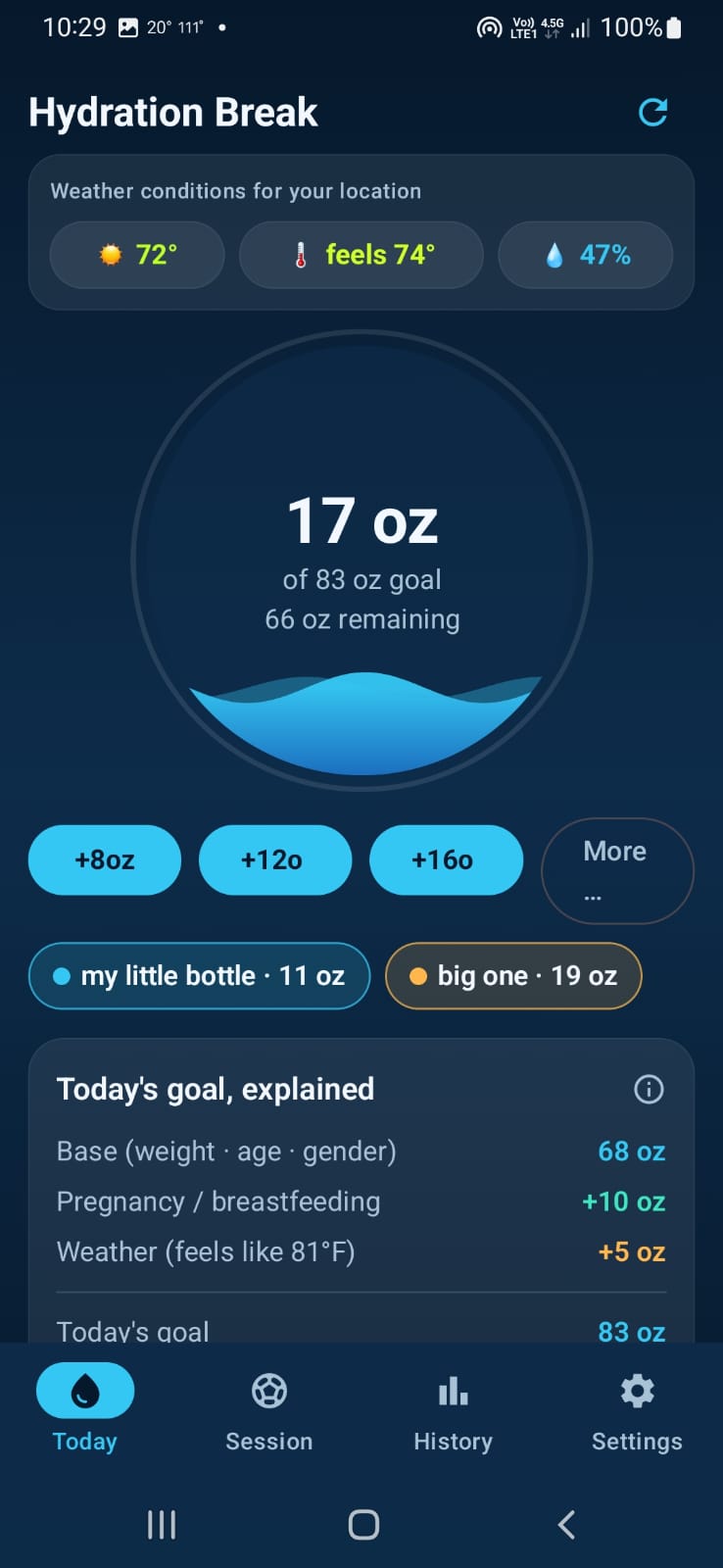
This is exactly the calculation the Hydration Break app runs for you every morning: EFSA-based need from your weight, age and gender; adjustments for pregnancy, kidney health and your outdoor exposure; and a live add-on from today's actual heat index, humidity and UV — with every line item shown and sourced in the app.
Get your number — for today's weather
Science-based, personal, and honest about where it comes from.
Keep reading
- What is a hydration break? Meaning & World Cup rules
- How hot weather changes how much water you need