Your water needs are not a constant. The same body that does fine on 2 liters during a mild office day can lose that much in sweat during a single hot afternoon outside. Yet most reminder apps — and most habits — treat hydration as one fixed daily number. The weather disagrees.
The thermometer lies: meet the heat index
Your body cools itself by evaporating sweat. Humidity slows that evaporation down, so at 88 °F with high humidity your body is under more heat stress than at 95 °F in a desert. Meteorologists capture this with the heat index — the "feels-like" temperature — computed from air temperature and relative humidity using a model published by the U.S. National Weather Service (NOAA, the Rothfusz regression).
That's why serious heat-safety systems — from FIFA's hydration break protocol to occupational-safety guidance — trigger on heat-stress measures, never on plain air temperature.
What heat does to your fluid needs
- At rest in comfortable conditions, you lose water steadily through breath, skin, and urine — this is your baseline need (see how much water per day).
- As the feels-like temperature passes roughly 75 °F / 24 °C, sweating begins contributing meaningfully, and losses rise stepwise with every few degrees.
- In serious heat (feels-like above 90–95 °F / 33–36 °C), even non-athletes sweat continuously outdoors. During sport, sweat rates commonly reach 0.5–2 liters per hour (ACSM).
- Direct sun adds radiant load: a high UV index on a clear day means extra heat absorbed by your skin — beyond what the air temperature shows.
So how much extra should you drink?
There is no single magic number — it depends on the heat index and how much of your day you actually spend in it. As a practical, evidence-informed range for daily life (not competition):
| Feels-like (heat index) | Mostly indoors | Mixed day | Mostly outdoors |
|---|---|---|---|
| Below 75 °F / 24 °C | — | — | — |
| 75–81 °F / 24–27 °C | ~3 oz | ~5 oz | ~7 oz |
| 81–86 °F / 27–30 °C | ~6 oz | ~10 oz | ~14 oz |
| 86–91 °F / 30–33 °C | ~10 oz | ~17 oz | ~24 oz |
| 91–97 °F / 33–36 °C | ~14 oz | ~24 oz | ~33 oz |
| Above 97 °F / 36 °C | ~18 oz | ~30 oz | ~42 oz |
Extra beverage intake per day on top of your personal base need; add a further ~5 oz when the UV index is very high (8+) and you're outdoors. These are the same tiers the Hydration Break app applies automatically — capped at safe totals.
Signs you're falling behind
- Thirst (already a lagging signal in heat), dark yellow urine, headache, fatigue.
- In serious cases: dizziness, cramps, confusion — treat these as heat-illness warning signs, get to shade and cool fluids, and seek help if they don't resolve.
- On very long, sweaty efforts, plain water alone isn't enough — include electrolytes (sodium) with food or sports drinks. Drinking far beyond thirst and sweat losses can be dangerous too (hyponatremia).
Let the forecast do the math
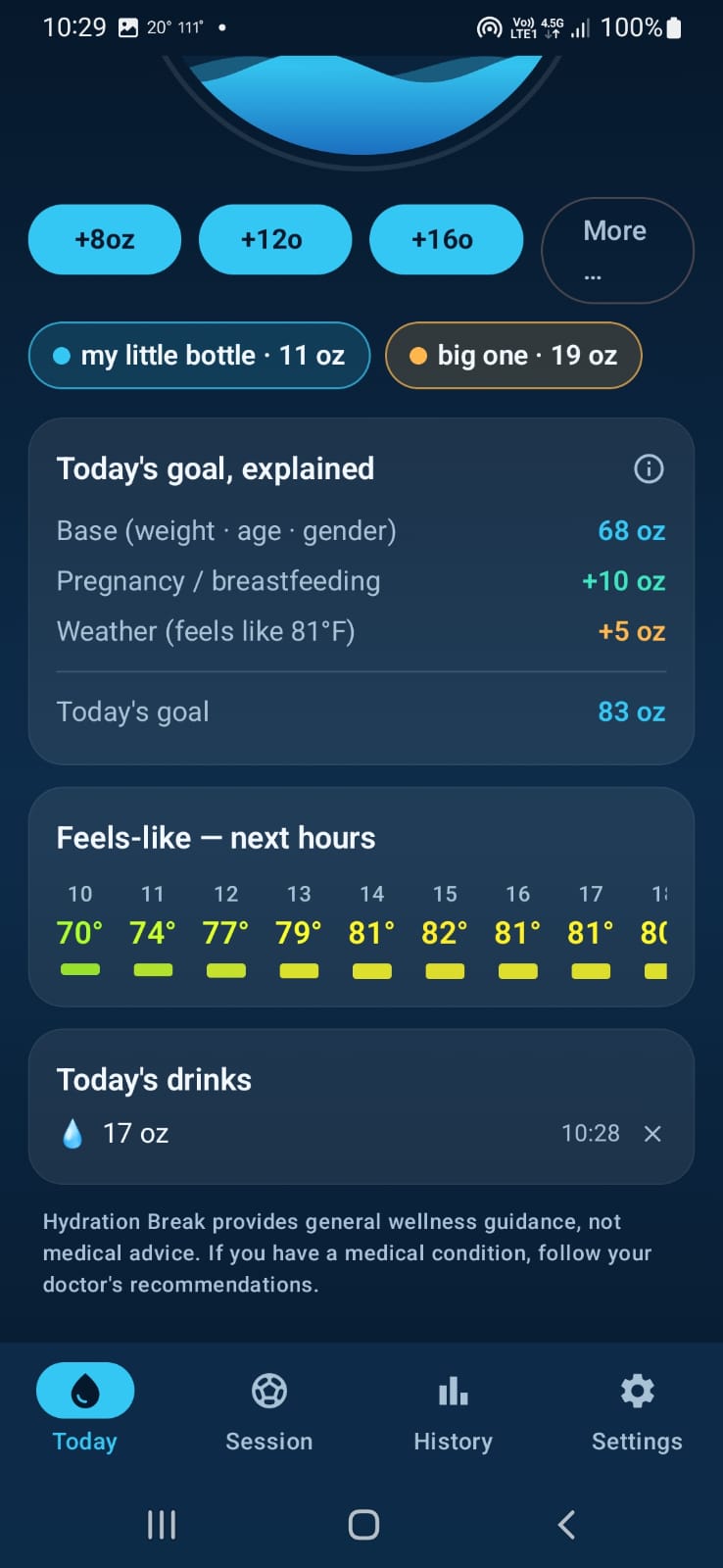
Nobody wants to check a heat-index chart every morning. The Hydration Break app does the whole pipeline automatically: it reads the hourly feels-like temperature, humidity and UV for your exact location, adjusts your science-based daily goal in real time, warns you before the hottest hours, and scales your workout hydration breaks with a live heat multiplier.
Your goal, weather-adjusted daily
Stop guessing what the heat costs you. See it, in ounces, every morning.
Keep reading
- What is a hydration break? Meaning & World Cup rules
- How much water should you drink a day? The science-based answer