A hydration break is a short, officially sanctioned pause in play that lets athletes drink fluids and cool their bodies down. If you've watched the 2026 FIFA World Cup, you've seen them: the referee signals, play stops, and for a few minutes both teams head to the touchline for water, electrolyte drinks and ice towels. Announcers now say the phrase so often that "hydration break" has jumped from the rulebook into everyday language — and into how ordinary people think about training in the heat.
Where the term comes from
The idea was formalized by FIFA at the 2014 World Cup in Brazil. Faced with tropical heat and humidity, FIFA adopted a protocol based on the WBGT (wet-bulb globe temperature) — a measure that combines air temperature, humidity, sun and wind. When WBGT readings crossed the danger threshold (around 32 °C), referees were required to allow cooling breaks of roughly three minutes around the 30th and 75th minutes of the match. The first mandatory break in World Cup history was applied during the Netherlands–Mexico round-of-16 match in Fortaleza.
Other competitions followed — domestic leagues, continental tournaments, youth football, and parallel rules in tennis (heat rules allowing extra breaks between sets), rugby, and American football's preseason camps, where scheduled water breaks have long been standard safety practice.
With the 2026 World Cup played across the United States, Canada and Mexico in June and July — including afternoon kickoffs in genuinely hot cities — hydration breaks moved from an occasional footnote to a fixture of nearly every broadcast. That's how a technical term became a household one.
Why the breaks exist: the science
During intense sport, the body commonly loses 0.5–2 liters of sweat per hour — more in heat and humidity. Losing just 2% of body weight as fluid measurably degrades endurance, decision-making and skill. Heat compounds the problem: when the air is humid, sweat can't evaporate efficiently, so core temperature climbs faster.
Sports-medicine bodies such as the American College of Sports Medicine (ACSM) therefore recommend drinking small amounts at regular intervals — roughly every 15–20 minutes — rather than gulping a bottle when you finally feel thirsty. Thirst lags behind actual fluid loss, especially in older athletes and in hot weather.
How long is a hydration break?
- Professional football: about 3 minutes, typically once per half (around minutes 30 and 75), at the referee's discretion when conditions are extreme.
- Tennis: heat rules allow a 10-minute break between certain sets when heat-stress thresholds are exceeded.
- Your own training: you don't need a referee — a practical rhythm is a brief pause every 15 minutes, drinking roughly 3–8 oz (90–250 ml) per break depending on your intensity, the heat and your body size.
Bringing World Cup rules to your own workouts
Elite teams have staff calculating sweat rates and WBGT. Amateurs mostly have… a vague feeling of thirst. That gap is exactly why we built the Hydration Break app:
- Pick your sport (13 of them, from football to golf), intensity, and whether you're outdoors.
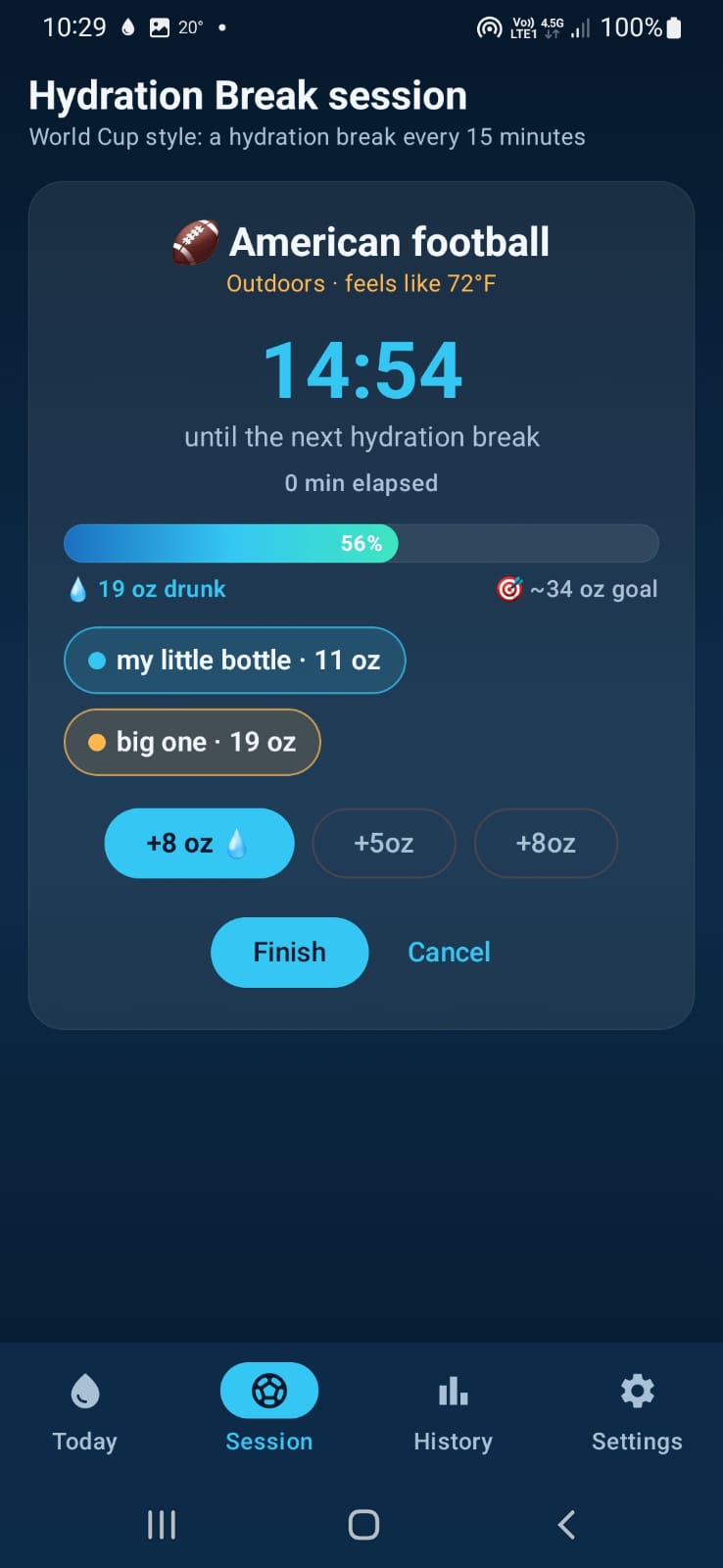
- The app checks the live feels-like temperature for your location and computes a per-break amount — intensity × duration × heat multiplier × your body weight.
- Then it runs your personal World Cup protocol: a hydration break every 15 minutes, with a live countdown notification and one-tap logging, even with your phone locked.
Run your own hydration breaks
Weather-smart water goals all day, World Cup–style breaks when you train.
Keep reading
- How hot weather changes how much water you need
- How much water should you drink a day? The science-based answer